Chinese units conversion chart
Chinese units such as jin, catty, mu, li and chi are easy to convert when the source is modern mainland China. The hard part is knowing when that modern value is safe to use.
Quick answer: for current mainland China, 1 jin is 0.5 kg, 1 catty is usually the same as 1 jin, 1 mu is 666.67 square meters, 1 li is 0.5 km, and 1 chi is 33.33 cm. Slow down for historical, regional, Taiwan, Hong Kong or specialist references.
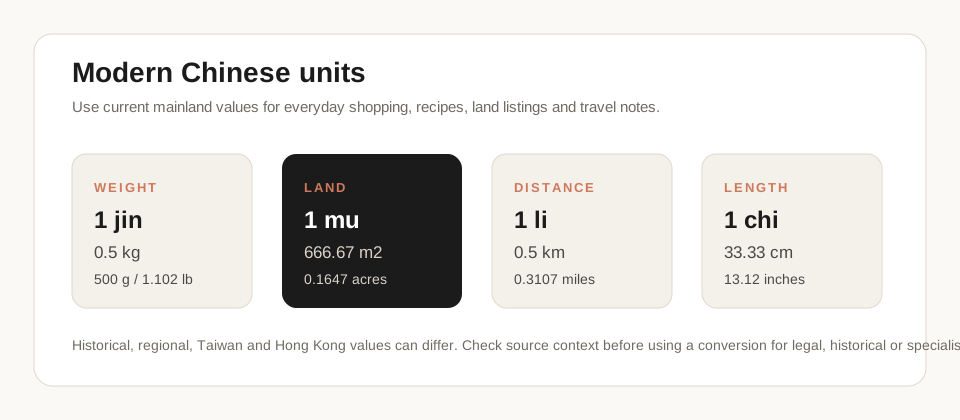
01 /Core modern Chinese unit values
| Chinese unit | Modern mainland value | Best converter | Common use |
|---|---|---|---|
| jin / catty | 0.5 kg = 500 g = 1.102 lb | Jin to kg | Food, groceries, body weight, shipping |
| liang | 50 g | Liang to grams | Food, tea, traditional recipes |
| qian | 5 g | Qian to grams | Small weights and older references |
| mu | 666.67 m2 = 0.1647 acres | Mu to acres | Farmland, land listings, property |
| qing | 100 mu = 6.667 hectares | Qing to acres | Large land areas |
| li | 0.5 km = 0.3107 miles | Li to miles | Travel notes, books, distance references |
| chi | 33.33 cm = 13.12 inches | Chi to inches | Length, clothing, older descriptions |
| cun | 3.333 cm = 1.312 inches | Cun to cm | Small length references |
02 /When the modern value is enough
If you are reading a current mainland Chinese recipe, grocery note, product weight, property listing or travel description, the modern value is usually the right starting point. That is why searches such as "jin to kg", "catty to pounds", "mu to acres", "li to miles" and "chi to inches" can be answered with fixed formulas.
For example, a listing that says 3 jin of fruit means about 1.5 kg. A farmland listing that says 10 mu means about 1.647 acres. A distance described as 10 li means about 5 km or 3.107 miles. These are simple conversions when the source is a modern mainland context.
03 /Choose the right Chinese unit converter
Broad searches for "Chinese unit converter" or "Chinese measurement units" usually mix several different problems. Pick the converter by the source type first, then keep the original unit visible beside the converted value.
Food, groceries and shipping weight
Start with jin to kg, catty to pounds, liang to grams or qian to grams. These cover most modern mainland food weights, market notes, recipes and small product weights.
Farmland, property and planning area
Use mu to acres, square meters to mu, acre to mu or qing to acres. Mu is the practical unit for many current land listings.
Length, distance and older descriptions
Use chi to inches, cun to cm, zhang to meters or li to miles. These are useful for reading older descriptions, dimensions and travel notes.
Chinese numbers and RMB subunits
Use wan to number and yi to number for large-number notation. Use jiao to yuan and fen to yuan only for RMB subunits, not foreign exchange rates.
04 /When the source context changes the answer
Chinese units have a long history, and older values did not always match modern mainland values. Regional markets can also differ. Taiwan catty, Hong Kong catty, historical jin, and specialist traditional references may need a different conversion. If the source is legal, historical, medical, academic or archival, treat the converter as a first-pass reading aid, not the final authority.
The safest workflow is to identify the place, period and domain first. A current mainland grocery page, a Qing-era document, a Taiwan market price and a Hong Kong product listing should not automatically be interpreted with the same value.
05 /Examples by search intent
Jin to kg
Use 1 jin = 0.5 kg for modern mainland groceries, recipes, body weight talk and shipping notes. For reverse lookup, 1 kg equals 2 jin.
Catty to pounds
In mainland China, catty is commonly used as the English name for jin, so 1 catty is about 1.102 pounds. Check region if the source says Taiwan or Hong Kong catty.
Mu to acres
Use 1 mu = 666.67 square meters = 0.1647 acres for modern mainland farmland and land area listings. For large areas, 100 mu is about 16.47 acres.
Li to miles
Use 1 modern li = 0.5 km = 0.3107 miles for quick travel and reading context. Older literary uses can be less precise.
Chi to inches
Use 1 modern chi = 33.33 cm = 13.12 inches. For clothing or body measurements, confirm whether the source actually uses metric centimeters instead.
Chinese unit converter
When the query is broad, start from the unit category: weight, land area, distance, length, volume, money subdivision or large-number notation.
06 /Quick FAQ
What is the most common Chinese weight unit?
Jin is the common everyday mainland weight unit. Use jin to kg for groceries, food weights, body weight talk and shipping notes.
Is catty the same as jin?
In mainland China, catty usually translates jin, so 1 catty equals 0.5 kg. Check the region before using that value for Taiwan, Hong Kong or Southeast Asian market sources.
Which Chinese land unit should I use?
For most modern mainland land listings, use mu. One mu is 666.67 square meters, about 0.1647 acres or 0.0667 hectares.
Are these formulas professional advice?
No. They are practical reading aids for modern mainland values. Legal, medical, historical, academic or safety-critical contexts should be checked against the original authoritative source.